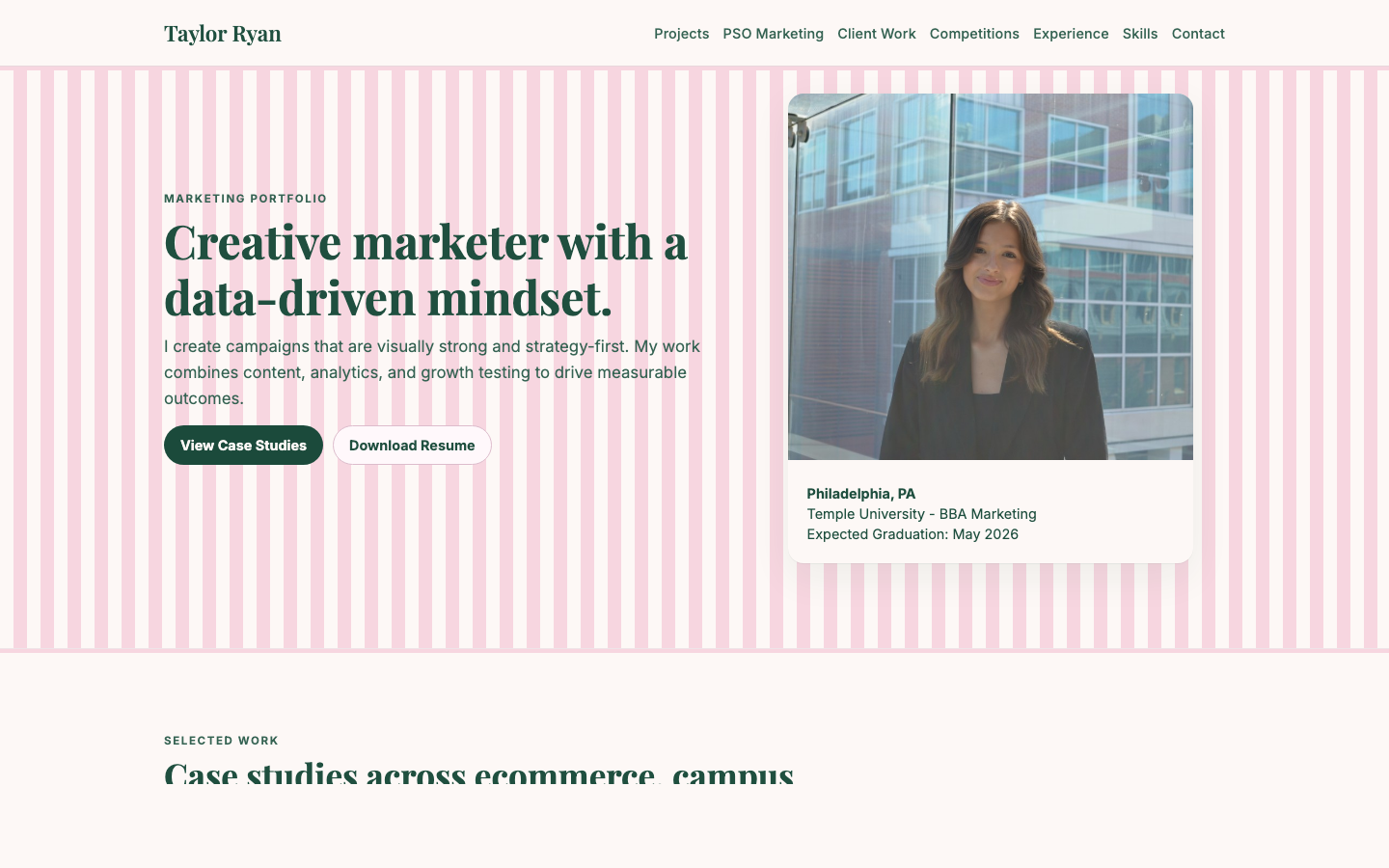
My public marketing portfolio — one long-form site where I show real work with outcomes: Etsy growth, PSO leadership, a live client website, and competition experience. I built and ship it with HTML, CSS, and JavaScript, and host it for free on GitHub Pages straight from my repo.
Built with
HTML · CSS · JS
Hosting
GitHub Pages
Live URL
taylorryan32.github.io
I needed a single place recruiters and clients could land to see how I think — not just a list of job titles. The portfolio had to show strategy and creative execution together: proof from my Etsy shop, real marketing work for Temple’s Professional Sales Organization, a client website I designed and built, and sales competition experience.
It also had to be easy to update and cheap to host while I’m still in school. GitHub Pages made sense: push to the repo, and the public site updates from the main branch. No separate hosting bill, and the URL is stable for a resume line.
A clear above-the-fold story: who I am, how I work (creative + data-driven), and CTAs to case studies and my resume. Sticky nav with anchor links so visitors can jump to Projects, Experience, Skills, or Contact without losing context.
A “Selected work” section with cards for Etsy, PSO Instagram, the PSO Squarespace redesign, and the pickleball coach client site — each tied to a longer section with scope, execution, and outcomes (sales numbers, archive context, live links).
Full write-ups: TaysTailoredCo with listing strategy and results; PSO with posting cadence, templates, and an archived website screenshot; the pickleball project with booking integration, pricing, testimonials, and a link to the live client domain.
NISC and Fox Sales Competition highlights, plus a reverse-chronological experience section so leadership and internships read as a coherent story, not random bullets.
Tools and capabilities; a carousel of real Etsy five-star reviews; footer with email, resume download, and LinkedIn — everything a hiring manager needs in one pass.
The page is built to read cleanly on phone and desktop, because most people will open a portfolio link from email or LinkedIn on their phone first.
I learned the basics of connecting a GitHub repo to Pages, keeping the live site in sync with what’s on main, and treating deploys as part of the workflow — not a scary separate step.
Refining the site pushed me to attach numbers, screenshots, and links everywhere I could. “Managed Instagram” hits harder next to frequency, timeframe, and an archive note.
Structuring a long single page taught me to use clear section breaks and anchors so it doesn’t feel endless — same content as multiple routes, but simpler to maintain.
I used Cursor to move faster on layout and fixes. The habit of shipping a version, getting feedback, and updating the repo is as valuable as any one feature.
Full portfolio on GitHub Pages — case studies, proof, and contact.